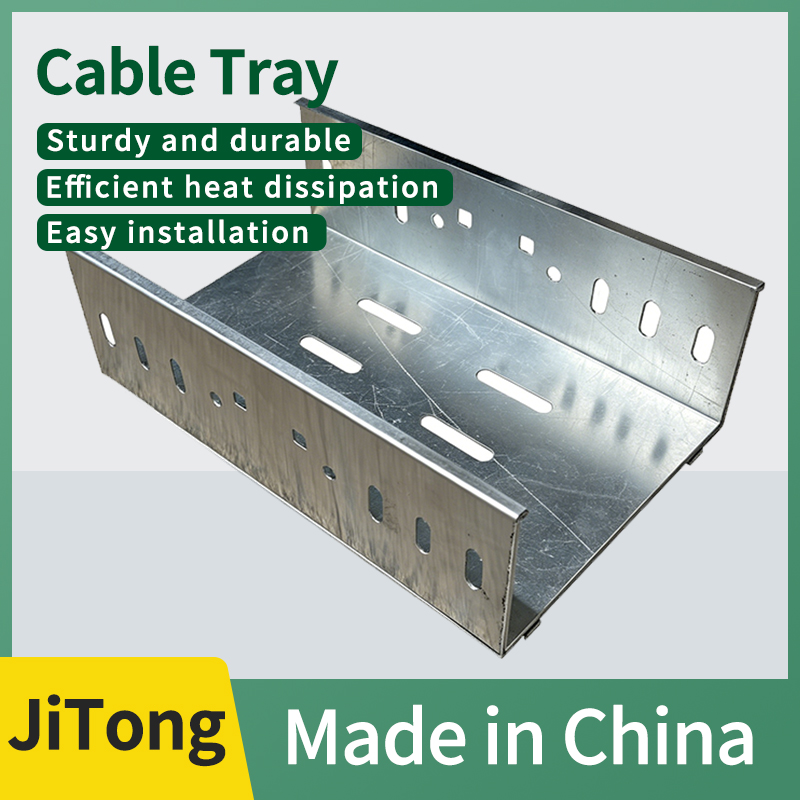
Dimensions (Width × Height, unit: mm):
(1) Height 50 Series: 100×50, 150×50, 200×50, 300×50, 400×50
(2) Height 100 Series: 100×100, 150×100, 200×100, 300×100, 400×100, 500×100, 600×100, 800×100
(3) Height 150 Series: 200×150, 300×150, 400×150, 500×150, 600×150, 800×150, 1000×150
(4) Height 200 Series: 300×200, 400×200, 500×200, 600×200, 800×200, 1000×200, 1200×200
(5) Extra‑long Span / Special Widened Cable Tray for Power Plants: 1000×100, 1000×150, 1000×200, 1200×200
Plate Thickness (unit: mm): 1.0/1.2/1.5/2.0/2.5/3.0/3.5
Ⅰ. Product Definition:
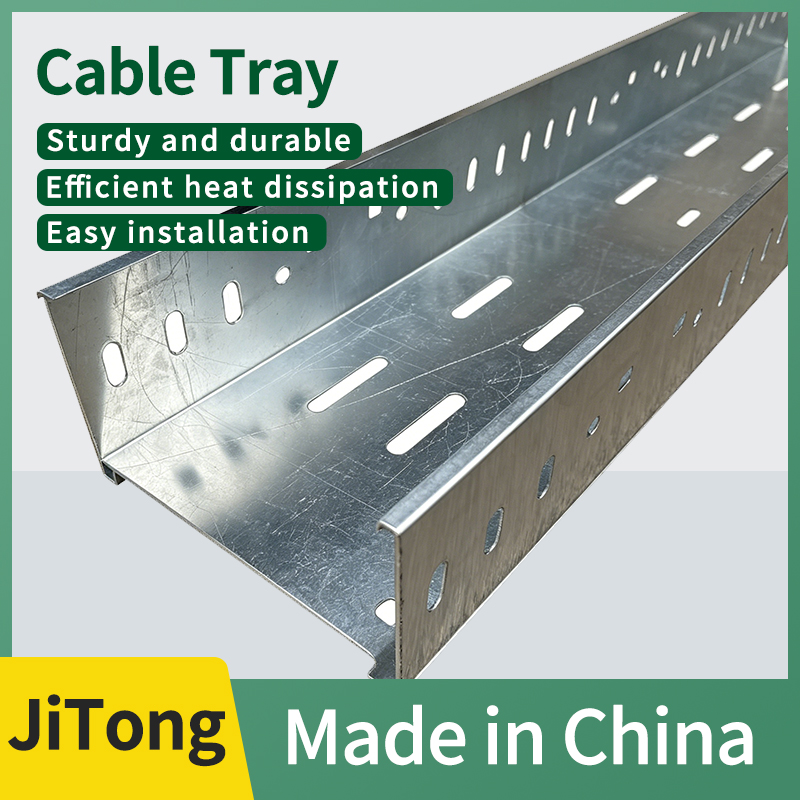
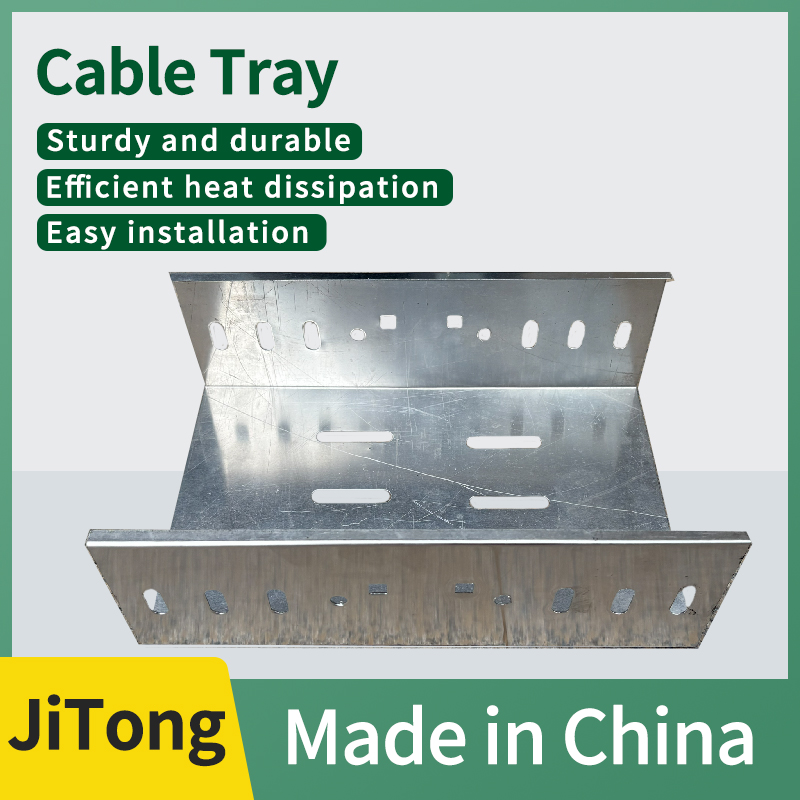
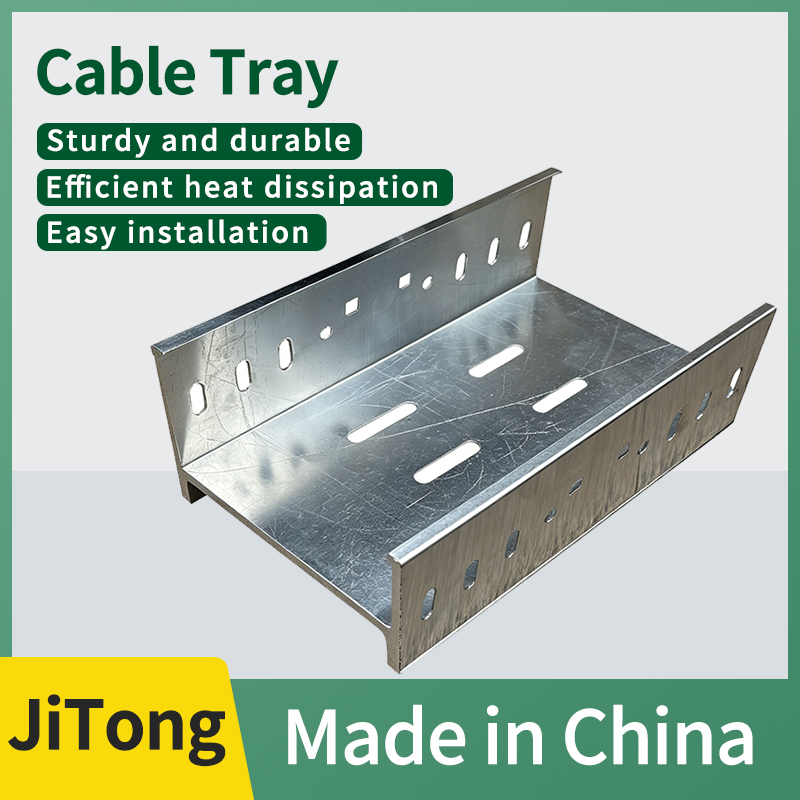
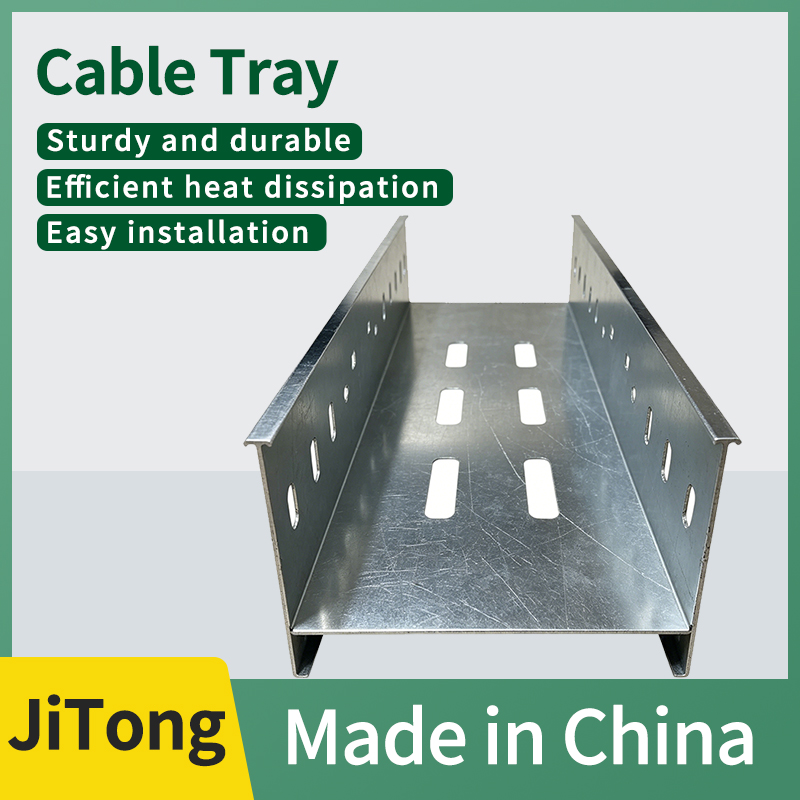
Hot-dip galvanized tray-type cable tray (model XQJ-P), made of Q235 cold-rolled steel plate, is integrally bent and stamped. The bottom plate is covered with waist-shaped heat dissipation and ventilation holes, and both sides are equipped with complete vertical edge baffles. After forming, it undergoes overall hot-dip galvanizing for corrosion protection. It is a semi-transparent universal cable tray, which can be equipped with galvanized cover plates. It combines heat dissipation, load-bearing capacity, and basic protection, making it the preferred cable tray for mixed wiring of strong and weak electricity. Optional accessories include hot-dip galvanized cover plates, divider plates, horizontal bends, vertical bends, tees, crosses, reducers, a full set of hot-dip galvanized connectors, and bracket columns.
II. Production Process
1. Forming Process: Steel plate cutting → CNC bending to form the bottom and side plates → Stamping dense cooling holes on the bottom plate (standard waist holes 10×30mm, hole spacing 50mm) → Drilling (connection holes, lifting holes) → Processing of supporting elbows, tees, reducers, partitions, and cover plates; the bottom of the heavy-duty model can be pressed with reinforcing ribs to enhance load-bearing capacity.
2. Hot-dip galvanizing anti-corrosion process (same as hot-dip galvanizing bath/ladder rack) degreasing and degreasing → acid pickling and rust removal → plating activation → soaking in 450~480℃ zinc liquid for 3~5min → zinc coating cooling and passivation by shaking (≤5mm) with zinc layer ≥65μm, thick plate ≥86μm, zinc layer adhesion ≥610g/㎡; metallurgically bonded zinc-iron alloy layer, not prone to peeling due to knocks, salt spray test 3000h+, outdoor, coastal, chemical environment service life 15~20 years.
IV. Core Structural Features
1. Semi-transparent Punching on the Base Plate: Numerous heat dissipation holes ensure air circulation, addressing the issue of heat accumulation in enclosed slot-type trays;
2. Integrated Plate-type Base Plate: Unlike ladder trays, which are completely hollowed out, the entire cable is supported by a complete base plate, preventing thin cables and control wires from sagging or getting stuck;
3. Continuous High Riser Edges on Both Sides: Prevents cables from falling off and provides basic dust and debris protection;
4. Flexible Cover Plate Selection: Without a cover plate, it focuses on heat dissipation; with a cover plate, protection and shielding are greatly improved, approaching the effect of slot-type trays.
V. Core Advantages
1. Heat dissipation + protection Balanced heat dissipation is superior to the trough type, while protection, shielding, and resistance to mechanical damage are superior to the ladder type, making it the most versatile overall; the cable operating temperature is 10~15℃ lower than the trough type, delaying insulation aging.
2. Excellent load-bearing performance: The entire base plate is evenly stressed, coupled with reinforced ribs, resulting in a uniformly distributed load that is higher than that of ladder racks of the same specification. It is suitable for dense laying of multiple circuits and a mix of thick and thin cables, providing stable support for heavy-duty high-voltage cables.
3. The wiring is neat and easy to fix. The holes on the baseboard can be directly used to tie and fix cables. The strong and weak electricity zones are neatly divided, and fine signal lines and optical fibers are not easily scattered. In the later stage, cables can be added or removed without dismantling the cover plate for maintenance.
4. Hot-dip galvanized with long-lasting anti-corrosion thick zinc coating and cathodic protection, it is resistant to salt spray, moisture, mild acids and alkalis, suitable for both indoor and outdoor use, and can be applied in coastal areas, sewage treatment plants, and chemical plant areas.
5. When strong and weak currents are laid together without a cover plate, power cables can be laid; when a metal partition plate is added, strong and weak currents can be laid in the same slot; when a cover plate is added, basic electromagnetic shielding is provided, allowing the laying of instrument and control cables without the need for two sets of trays, thus saving costs.
6. Maintain a convenient semi-open structure, with intuitive and visible wiring, making inspection, line change, and expansion operations simple.
VII. Applicable Scenarios
1. Areas with mixed strong and weak electricity: main strong and weak electricity cables in factory power distribution rooms, central control rooms, data centers, and office buildings;
2. General industrial workshops, new energy factories, photovoltaic plant areas, tunnels, and underground garages (requiring heat dissipation and protection of thin cables);
3. Coastal factories, wastewater treatment plants, and chemical light corrosion workshops (long-term anti-corrosion of hot-dip galvanizing);
4. Computer rooms and building integrated wiring, where power cables, network cables, fire control lines, and instrument cables are laid simultaneously;
5. Places with a large number of cables of various thicknesses, requiring both heat dissipation and prevention of small cables from falling and getting stuck.
IX. Precautions for Construction and Installation
1. The cut and drilled sections on site must be coated with zinc-rich repair paint to prevent bare steel corrosion;
2. All connecting pieces, support arms, and columns must be uniformly equipped with hot-dip galvanized parts to avoid electrochemical corrosion of dissimilar metals;
3. When laying strong and weak electrical cables on the same tray, metal separator plates must be added for isolation; dust-proof and outdoor scenes should be equipped with matching galvanized cover plates;
4. Grounding jumper wires must be installed along the entire long-distance line to ensure the overall equipotential conduction of the cable tray;
5. For heavy-duty trays with a width of over 600mm, support points for the support arms should be densified to prevent the cable tray from deflecting and deforming under long-term load.